
Key Highlights
- India’s cotton textile exports — especially cotton fabrics — have fallen by about 30% since the United States introduced steep tariffs in August 2025 under Trump-era trade policies.
- The U.S. imposed tariffs up to 50% on Indian textile and apparel shipments, significantly reducing competitiveness in India’s largest export market.
- The United States accounts for about one-third of India’s total textile exports, with cotton-based products forming the majority of these shipments.
In late 2025, the United States sharply raised import tariffs on a range of Indian goods including cotton fabrics, made-ups, and ready-made garments marking a major escalation in trade tensions between the two countries. Within a few months of the tariff hikes, India’s cotton textile exports to the U.S. dropped by nearly 30%, a phenomenon widely referred to in industry circles as the “Trump effect.” Export Genius explains how much cotton fabrics India export to the world and India’s top export destinations of cotton fabrics and what would be the impact of Trump’s tariffs on India’s cotton industry.
In this blog, we have taken following HS Codes for showcasing stats:
- HS Code 52: Cotton
- HS Code 61: Knitted or Crocheted Apparel and Clothing
- HS Code 62: Not Knitted or Crocheted Apparel and Clothing
What Happened?
Tariff Increase Timeline:
The U.S. began imposing higher tariffs on Indian imports in August 2025, initially at a punitive level and soon doubling the levy to 50% on many textile products exported from India.
Export Impact:
According to Export Genius, a leading trade intelligence platform, Indian cotton exports totalled USD 6 billion in 2024. In 2025, the figure was USD 3 billion from Q1 to Q3, estimating into a 30% decline in export volumes. Understand from the following chart:
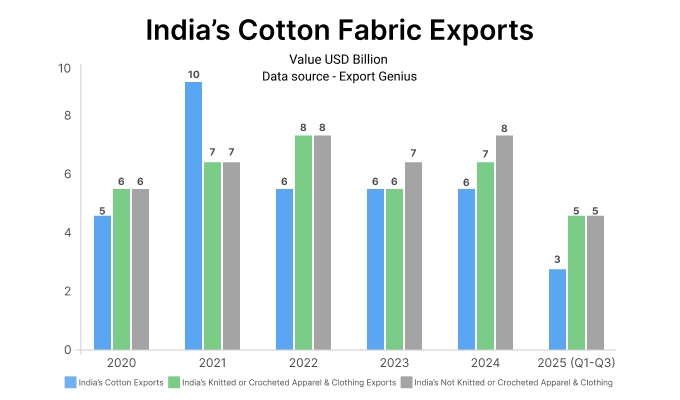
| Year | India’s Cotton Exports | India’s Knitted or Crocheted Apparel & Clothing Exports | India’s Not Knitted or Crocheted Apparel & Clothing |
| 2020 | 5 | 6 | 6 |
| 2021 | 10 | 7 | 7 |
| 2022 | 6 | 8 | 8 |
| 2023 | 6 | 6 | 7 |
| 2024 | 6 | 7 | 8 |
| 2025 (Q1-Q3) | 3 | 5 | 5 |
******Value USD Billion
Market Exposure:
The U.S. accounts for a significant share of India’s textile export market, roughly one-third of all cotton-based shipments. That makes these tariffs particularly damaging for cotton fabrics and related sub-segments.
Do you know who are India’s top export destinations of cotton fabrics? Well, Export Genius, a leading market intelligence platform is here to give you the right answer. Look at the chart below where you will find data visualization of India’s export partners of cotton fabrics.

| Countries Importing Indian Cotton | 2024 | 2025 (Q1-Q3) | Countries Importing Indian Apparel and Clothing Knitted & Not Knitted | 2024 | 2025 (Q1-Q3) |
| Bangladesh | 2 | 2 | United States | 2 | 4 |
| China | 0.4 | 1.6 | United Kingdom | 0.6 | 0.7 |
| Vietnam | 0.3 | 1.7 | United Arab Emirates | 0.6 | 0.6 |
| Sri Lanka | 0.2 | 2 | Germany | 0.4 | 0.5 |
| Egypt | 0.1 | 1.8 | Netherlands | 0.3 | 0.5 |
******Value USD Billion
Why Cotton Fabrics Were Hit Hardest
India’s textile ecosystem has long been globally competitive, driven by abundant cotton production, large labor pools, and established manufacturing clusters across states like Tamil Nadu, Punjab, Haryana, and Gujarat. Reasons on why India’s cotton industry is hit from the current market scenario.
- Heavy U.S. Dependence
The U.S. was among the largest buyers of Indian cotton fabrics. When tariffs suddenly jumped, price competitiveness eroded instantly, leading American buyers to either reduce orders, delay shipments, or seek alternatives.
- Thin Profit Margins
Textiles, especially cotton products operate on relatively thin margins. A 50% tariff adds cost too steep to absorb without cutting prices heavily, a move most exporters cannot sustain long. Many Indian exporters reported offering discounts just to retain buyers.
- Inventory & Production Disruptions
With demand weakening, production volumes were slashed, inventories piled up, and cash flows tightened. Major textile hubs such as Tiruppur, Ludhiana, and Panipat faced operational slowdowns.
Shift in Business Model
Some manufacturers, especially in cotton-heavy regions are restructuring operations, focusing more on domestic demand or diversifying product mixes to maintain cash flow.
- Broader Trade & Market Dynamics
While the United States remains a major export destination, the Trump effect has pushed Indian exporters to rethink global strategy.
- Diversification Efforts
Industry bodies and government officials are looking to expand exports to Europe, the UK, the Middle East, Africa, and Asia as alternatives to U.S. markets. Some exporters have already begun outreach to new buyers in these regions.
- Government Support Measures
To cushion the blow, the Indian government extended duty-free imports of cotton (lifting around 11% in import duties) to reduce input costs and help exporters remain competitive globally.
What This Means for India’s Textile Future
- Short-Term Pain, Long-Term Shifts
The immediate impact lower exports, tighter cash flows, factory slowdowns — underscores India’s vulnerability to sudden tariff shocks. But it also accelerates structural shifts like market diversification, increased focus on manufacturing for domestic brands, and supply chain resilience.
- Geopolitical & Trade Negotiations
Efforts at bilateral talks with the U.S. and trade-pact negotiations with other partners could shape future export landscapes. Completing key FTAs and negotiating tariff reductions may become strategic priorities.
- Innovation & Value Addition
Greater emphasis on value-added products (beyond basic cotton fabrics) including technical textiles, blended fabrics, and fashion apparel. This could help firms reduce dependency on one market and command higher margins globally.
The Bottom Line
The “Trump effect” on Indian cotton fabrics exports, a roughly 30% decline following U.S. tariff hikes. This highlights how quickly international trade policy can reshape industry economics. While the immediate outlook shows disruption and revenue loss, this moment may also catalyze strategic diversification, policy responses, and deeper global integration for India’s textile sector. Access the Export Genius dashboard and explore cotton fabric export data by country, buyer & HS Code and more.
Stop Guessing. Start Trading Smarter—Book a Demo!