
Key Highlights
- Historic FTA Finalized: India and the EU conclude a landmark trade pact, covering goods, services, investment, and sustainability.
- Market Access Boost: The deal cuts tariffs, eases regulations, and opens a $20+ trillion combined market for exporters and investors.
- Global Trade Reset: Positions India and the EU as key partners amid supply-chain shifts and rising global trade fragmentation.
In a moment heavy with symbolism and strategic consequence, India and the European Union sealed a long-awaited Free Trade Agreement (FTA). What this deal is? Who will get benefit? What is the impact on global trade? Export Genius, a leading import export trade data platform answers key questions related to India-EU deal with analysis of crucial stats and past market scenario of India and the European Union.
What?
India and the European Union closed a “landmark” free trade agreement on 27 Jan 2026, touted as the “mother of all deals,” Indian Prime Minister Narendra Modi said during a speech at the India Energy Week.
According to EU trade data, the FTA with the EU, which represents about 25% of global GDP and about a third of global trade, will also complement India’s deals with Britain and the European Free Trade Association, Modi said.
The agreement caps more than two decades of painstaking negotiations and partnership-building between two of the world’s largest democratic markets. India and the EU have been strategic partners since 2004, a relationship rooted in shared democratic values, multilateralism and a commitment to a rules-based international order. Their ties, however, stretch back even further-to 1962-when India became one of the first countries to establish diplomatic India-EU trade relations with the European Economic Community, the EU’s precursor.
Who?
President of the European Council joined Prime Minister Narendra Modi at the India-EU Summit, fresh from their role as Chief Guests at India’s Republic Day celebrations.
When?
That the EU’s top leadership chose to attend India’s Republic Day as chief guests has not gone unnoticed in diplomatic circles. At the summit table, leaders framed the FTA as a “future-oriented” agreement – one that supports resilient supply chains, trusted technologies and sustainable growth. The deal is also positioned as a counterweight to the uncertainties unleashed by tariff wars and geopolitical fragmentation.
Why?
The timing of the deal could hardly be more dramatic. The global economy is navigating renewed turbulence: US President Donald Trump’s return to aggressive tariff postures has unsettled markets, supply chains remain fragile, and the Russia-Ukraine war shows no sign of resolution. Against this backdrop, an India-EU FTA sends a strong signal in favour of open, predictable and diversified trade at a moment when economic nationalism is again on the rise.
According to India trade data, India’s bilateral trade with EU stood USD 157 billion in 2024 and USD 121 billion from Q1 to Q3 of 2025. Export Genius visualizes yearly trends of India-EU bilateral trade.
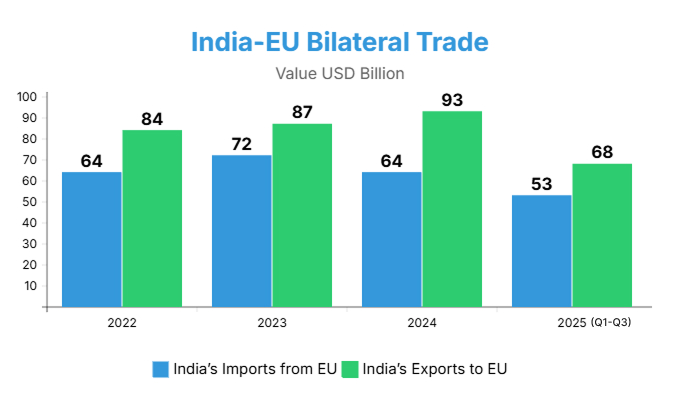
| Year | India’s Imports from EU | India’s Exports to EU |
| 2022 | 64 | 84 |
| 2023 | 72 | 87 |
| 2024 | 64 | 93 |
| 2025 (Q1-Q3) | 53 | 68 |
*****Value USD Billion
Over the past decade, European companies have expanded their footprint in India’s manufacturing, clean energy and digital sectors, while Indian firms from IT services to pharmaceuticals have deepened their presence across Europe.
The FTA is also the economic pillar of a much broader strategic convergence. Over the past few years, India and the EU have woven together cooperation across defence and maritime security, clean energy and climate action, digital technologies, space, and connectivity. The establishment of the India-EU Trade and Technology Council in 2022, only the EU’s second such council after the one with the US, was a recognition that trade, technology and security are now inseparable.
For New Delhi, which has been facing the brunt of punitive U.S. tariffs, this deal could be a much-needed shot in the arm. Since Trump imposed 50% tariffs on the Asian economy in August last year, it has been looking at alternative markets for its exports and has entered into trade deals with several countries.
This is India’s fourth major trade deal since the U.S., India’s biggest export market and a major trading partner, imposed steep tariffs in August. It has entered a trade pact with the U.K., Oman and New Zealand.
According to EU import export data, India is the ninth largest trading partner of the EU, accounting for 2.4% of the bloc’s total trade in goods in 2024, far behind major partners like the U.S. (17.3%), China (14.6%), or the U.K. (10.1%). The EU’s main exports to India include machinery and appliances, transport equipment, and chemicals.
India’s top export partners in the EU markets are Netherlands, Germany, Italy, Spain, France and Belgium. Import export data uncovers following stats in graphics.

| Country | 2024 | 2025 (Q1-Q3) |
| Netherlands | 24 | 14 |
| Germany | 10 | 6 |
| Italy | 8 | 3 |
| France | 7 | 3 |
| Belgium | 6 | 3 |
| Spain | 4 | 4 |
*****Value USD Billion
Experts have said that even though India’s deal with the EU is a major milestone, it will not replace the need for an India-U.S. deal.
In 2024, India’s goods trade surplus with the U.S. was $45.8 billion, while for the EU it was substantially lower at $25.8 billion.
Security cooperation has accelerated too, with joint naval exercises in the Indian Ocean and growing dialogue on defence industrial collaboration. On climate and energy, Europe has become a key partner in India’s transition to renewables, green hydrogen and sustainable urban mobility.
Connectivity is another strategic thread. The India-EU Connectivity Partnership and the ambitious India-Middle East-Europe Economic Corridor (IMEC) reflect a shared interest in building transparent, sustainable infrastructure networks across continents. An FTA would give these strategic initiatives a powerful economic backbone.
Which?
India’s exporters of textiles, gems and jewellery and leather goods would get benefit from India-EU trade deal. Let’s understand how much exports of these goods went from India to EU from the graphics.
| Product | Export Value 2024 | Export Value 2025 (Q1-Q3) |
| Knitted or Crocheted Apparel & Clothing | 3 | 2 |
| Not Knitted or Crocheted Apparel and Clothing | 3 | 2 |
| Gems and Jewellery | 3 | 2 |
| Articles of Leather | 1 | 0.9 |
| Footwear with Leather | 1 | 0.6 |
| Raw Hides and Skins and Leather | 0.1 | 0.7 |
*****Value USD Billion
Here is a list of commodities which could get cheaper after India-EU trade deal:
- Cars
- Wine
- Medicines
- Electronic and High-Tech Machinery
- Steel and Chemical Products
Challenges Remain, But Momentum Is Real
Negotiations have not been easy. Differences over market access in sensitive sectors, environmental and labour standards, data flows and public procurement have, in the past, slowed progress. But officials on both sides say the geopolitical and economic context has changed the calculus. The need to de-risk supply chains away from over-dependence on any single geography and to uphold a rules-based trading system has injected fresh urgency into the talks.
The FTA announced today marked not just the conclusion of a long negotiation but the opening of a new chapter in India-EU relations, one that ties together economics, strategy and shared values more tightly than ever before.
In a world increasingly defined by uncertainty, the handshake in New Delhi is expected to resonate far beyond Raisina Hill: as a statement that two major democratic powers are choosing cooperation over confrontation and integration over isolation.
The Bottom Line
The India-EU FTA represents a major milestone in global trade, ending nearly two decades of negotiations and setting the stage for deep economic and strategic ties between India and the European Union. While the deal isn’t officially signed yet, it’s effectively finalized and sealed in principle — the remaining steps are formalities that will play out over the coming months.
Global trade is changing. The India–EU deal proves it—and Export Genius shows you where the opportunities lie. Schedule a demo today to know and analyse what’s happening in the global trade.
FAQs
1. What is the India-EU trade pact?
The India-EU trade pact is a comprehensive free trade agreement aimed at reducing tariffs, improving market access, and boosting trade in goods, services, and investment between India and the European Union.
2. Why is the India-EU trade pact considered a turning point for global trade?
The pact links two major economies at a time of global trade fragmentation, signaling a shift toward strategic, diversified, and rules-based trade partnerships.
3. When will the India-EU trade pact come into effect?
While negotiations are finalized, the agreement will come into force after legal review and ratification, likely in late 2026 or early 2027.
4. How will the India-EU trade pact impact global supply chains?
The deal is expected to diversify supply chains, reduce dependence on single markets, and strengthen India-EU trade corridors amid geopolitical uncertainty.
5. Which sectors benefit most from the India-EU trade deal?
Key beneficiaries include textiles, apparel, leather, gems and jewellery, engineering goods, pharmaceuticals, automobiles, and IT-enabled services.
6. How does the India-EU trade pact affect exporters and businesses?
Exporters gain from lower tariffs, clearer regulations, improved customs procedures, and access to a large, high-value consumer market.
7. What does the India-EU trade pact mean for India’s global trade strategy?
The pact supports India’s goal of diversifying export markets, reducing trade risks, and strengthening its role in global trade blocs.
8. How does this deal compare with other global trade agreements?
Unlike many bilateral deals, the India-EU pact is broad in scope, covering trade, investment, sustainability, and regulatory cooperation across multiple sectors.
9. Will the India-EU trade pact lower prices for consumers?
Yes, tariff reductions may lower prices of select imported goods, especially automobiles, machinery, luxury products, and consumer items over time.
10. Why should global investors track the India-EU trade pact?
The agreement enhances investor confidence by providing stable trade rules, improved market access, and long-term economic cooperation between two major markets.