
Key Highlights
- Economic Impact: The India-US trade deal influences tariffs, exports, and investment flows, shaping India’s growth and trade balance.
- Energy & Russian Oil: The agreement affects India’s energy strategy, including how it manages Russian oil imports amid global pressure.
- Strategic Shift: It reflects India’s effort to balance economic ties with the US while protecting energy security and supply stability.
Has India managed to secure the ‘father of all deals’ with the United States? Indian PM and the US President took everyone by surprise when they announced that the tariff rate on Indian goods to the US will be reduced to 18%. What does it mean for India? Will India stop importing Russian oil? How India-US trade deal affects economy? Export Genius answers all major questions related to this deal with global trade data and expert-level intelligence.
India-US bilateral trade
India and the United States share one of the most significant bilateral trade relationships in the world, with total goods and services trade reaching over $212 billion in 2024, up more than 8% year-on-year. India’s exports to the US totaled about $80 billion, while imports from the US reached $41 billion, resulting in a substantial trade surplus for India.
The two nations are also pursuing a comprehensive India-US trade deal aimed at reducing tariffs, expanding market access, and boosting investment across key sectors such as technology, pharmaceuticals, energy, and manufacturing. India has consistently ranked the US as its largest trading partner, with strong growth trends in exports of engineering goods, IT services, pharmaceuticals, and agricultural products. As India-US trade deal is finalised, both countries are targeting a $500 billion bilateral trade goal by 2030, reflecting deepening economic ties and strategic cooperation.
Export Genius, a leading trade intelligence platform provides clean and updated US trade data, containing crucial information on trade between India and the United States. Analyse this import export data through interactive charts and graphics.
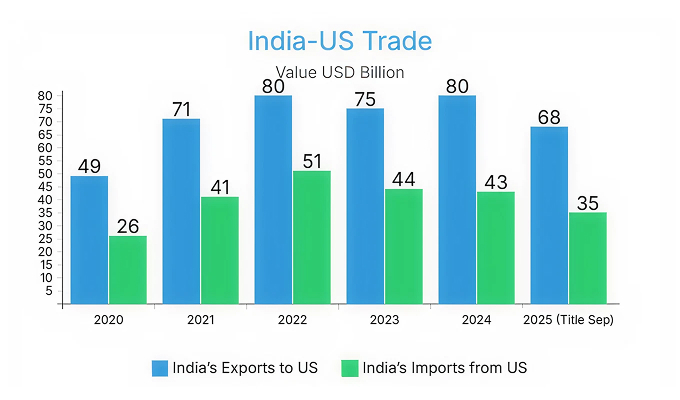
| Year | India’s Exports to US | India’s Imports from US |
| 2020 | 49 | 26 |
| 2021 | 71 | 41 |
| 2022 | 80 | 51 |
| 2023 | 75 | 44 |
| 2024 | 80 | 43 |
| 2025 (Title Sep) | 68 | 35 |
****Value USD Billion
Book A Demo for complete and authentic India US trade data.
India’s export commodities to the United States reflect a diverse and rapidly expanding trade portfolio, driven by high demand for engineering goods, pharmaceuticals, IT services, textiles, and organic chemicals. In recent years, India has strengthened its position as a key supplier to the US market, with exports of diamonds & gems, apparel, leather products, and pharmaceutical formulations showing robust growth. The India-US trade relationship has resulted in the United States becoming one of India’s largest export destinations.

| Product | 2024 | 2025 (Till Q3) |
| Electrical Machinery & Equipment | 80 | 17 |
| Pearls & Precious Stones | 12 | 4 |
| Pharma Products | 9 | 7 |
| Nuclear Reactors, Boilers, Machinery, etc. | 8 | 3 |
| Mineral Fuels & Oils | 6 | 3 |
| Articles of Iron & Steel | 4 | 1 |
| Other Made-up Textile Articles | 2 | 1 |
| Vehicles Other Than Railway or Tramway | 2 | 1 |
| Organic Chemicals | 2 | 1 |
| Not Knitted or Crocheted Apparel & Clothing | 2 | 1 |
*****Value USD Billion
Comparative advantage for India
With an 18% tariff, India has managed to secure a deal which places its duty rate lower than its neighbouring countries and competitors. India-US trade deal will cut tariff on 60% of Indian exports to the U.S. It will put India a shade lower than most south Asian competitors. It’s advantage for Indian exporters:
| Country | Tariff (%) |
| China | 34 |
| South Korea | 25 |
| Vietnam | 20 |
| Indonesia, Cambodia, Thailand, Malaysia | 19 |
| India | 18 |
| Taiwan, Japan | 15 |
| Australia, Singapore | 10 |
Will India stop buying Russian oil?
As part of the newly announced trade deal, US President Donald Trump claimed that India would stop buying Russian oil. “We spoke about many things, including trade, and ending the War with Russia and Ukraine. He agreed to stop buying Russian oil, and to buy much more from the United States and potentially, Venezuela,” Trump posted on Truth Social.
Export Genius, a leading import export data provider visualizes India’s oil from Russia so far.
| Year | Value USD Billion |
| 2020 | 64 |
| 2021 | 106 |
| 2022 | 173 |
| 2023 | 140 |
| 2024 | 143 |
| 2025 (Till Sep) | 50 |
The India–US trade deal marks an important shift in India’s global economic and energy strategy. While it strengthens trade ties, improves market access, and supports long-term economic growth, it also reshapes how India balances strategic partnerships with energy security, especially its dependence on Russian oil imports. The real impact of the deal will unfold through changing trade flows, tariff structures, and sourcing patterns across key sectors.
Global trade is evolving fast and staying ahead requires data, not guesswork.
Export Genius helps you track India–US trade movements, monitor oil import trends, and uncover opportunities with verified import–export intelligence.
👉 Book a demo today to see how real-time trade data can help you make smarter, faster decisions in a changing global market.
FAQs
1. What is the India-US trade deal about?
The India-US trade deal focuses on improving market access, reducing trade barriers, and strengthening cooperation in areas like manufacturing, technology, energy, and services.
2. How does the India-US trade deal impact India’s economy?
The deal can boost exports, attract investment, create jobs, and improve India’s trade ties with its largest export market, supporting long-term economic growth.
3. Does the India-US trade deal force India to stop buying Russian oil?
No. India has not officially agreed to stop buying Russian oil. Energy decisions are still guided by price, availability, and national energy security.
4. Why is Russian oil important for India?
Russian oil has been a cost-effective source of crude for India, helping control fuel prices and manage inflation during global energy disruptions.
5. Is India reducing its Russian oil imports?
India has reduced some Russian oil imports recently, but this is driven by market conditions and diversification efforts—not a complete ban.
6. How does the US view India’s Russian oil purchases?
The US has raised concerns and encouraged India to diversify energy sources, but there is no confirmed binding condition in the trade deal to halt Russian oil imports.
7. What sectors benefit most from the India-US trade deal?
Key beneficiaries include engineering goods, pharmaceuticals, IT services, electronics, renewable energy, and manufacturing exports.
8. Can the India-US trade deal affect fuel prices in India?
Indirectly, yes. Changes in oil sourcing and energy partnerships may influence fuel costs over time, depending on global prices and supply stability.
9. Will this trade deal replace India’s trade relationship with Russia?
No. India continues to follow a balanced trade strategy, maintaining relations with multiple partners, including the US, Russia, and the EU.
10. Why should businesses track the India-US trade deal?
The deal can reshape tariffs, export opportunities, supply chains, and energy flows, making trade data critical for informed business decisions.
11. How can exporters use trade data to benefit from the deal?
Trade data helps exporters track demand trends, identify buyers, monitor tariffs, and spot new opportunities in the US market.
12. Where can businesses track India-US trade and oil import trends?
Platforms like Export Genius provide verified import-export data, shipment trends, and market insights to help businesses stay ahead. Start a free trial today to access dashboard and explore global import export trade data.