
Key Highlights
- U.S. President Donald Trump has warned India that it could face higher tariffs on its goods if New Delhi doesn’t curb purchases of Russian crude oil.
- The U.S. has already imposed steep tariffs on Indian products, including a 50% duty on many items, partly as a penalty for Russian oil imports.
- Higher tariffs could raise costs for Indian exporters, especially in labour-intensive sectors like textiles, gems and jewellery, leather, and auto parts, reducing competitiveness in the U.S. market.
Global trade dynamics are once again under scrutiny due to two reasons – 1. Trump’s threat to impose new tariffs on India, if New Delhi does not meet Washington’s demand to curb purchases of Russian oil and 2. U.S. attacks on Venezuela. His comments follow months of trade negotiations after the United States doubled import tariffs on Indian commodities to 50% last year as punishment for its heavy buying of crude oil from Russia.
Export Genius tracks that story closely and analyze how US tariffs on India could impact India-US trade with trade insights. With global trade data, we try and bring valuable perspective on Trump India tariff impact 2026, India-US bilateral trade relations and India’s imports of crude oil from Russia.
Why Russian Oil Matters in the Trade Equation
Since the onset of the Russia-Ukraine conflict, India has sharply increased imports of discounted Russian oil to manage inflation and meet its growing energy demand. This move helped India stabilize fuel prices and reduce its import bill, but it also attracted criticism from Western economies attempting to economically isolate Russia. In the recent visit of Russian President to India, Putin and Modi had trade discussions on oil and other commodities that could reshape the business of both countries.
How much crude oil India imports from Russia and the United States? Crude oil comes under Harmonized System or HS Code 2709. In 2024, India’s oil imports from Russia totalled USD 143 billion, up from USD 140 billion reported a year earlier. Export Genius showcases yearly trends of India Russian oil imports 2026.
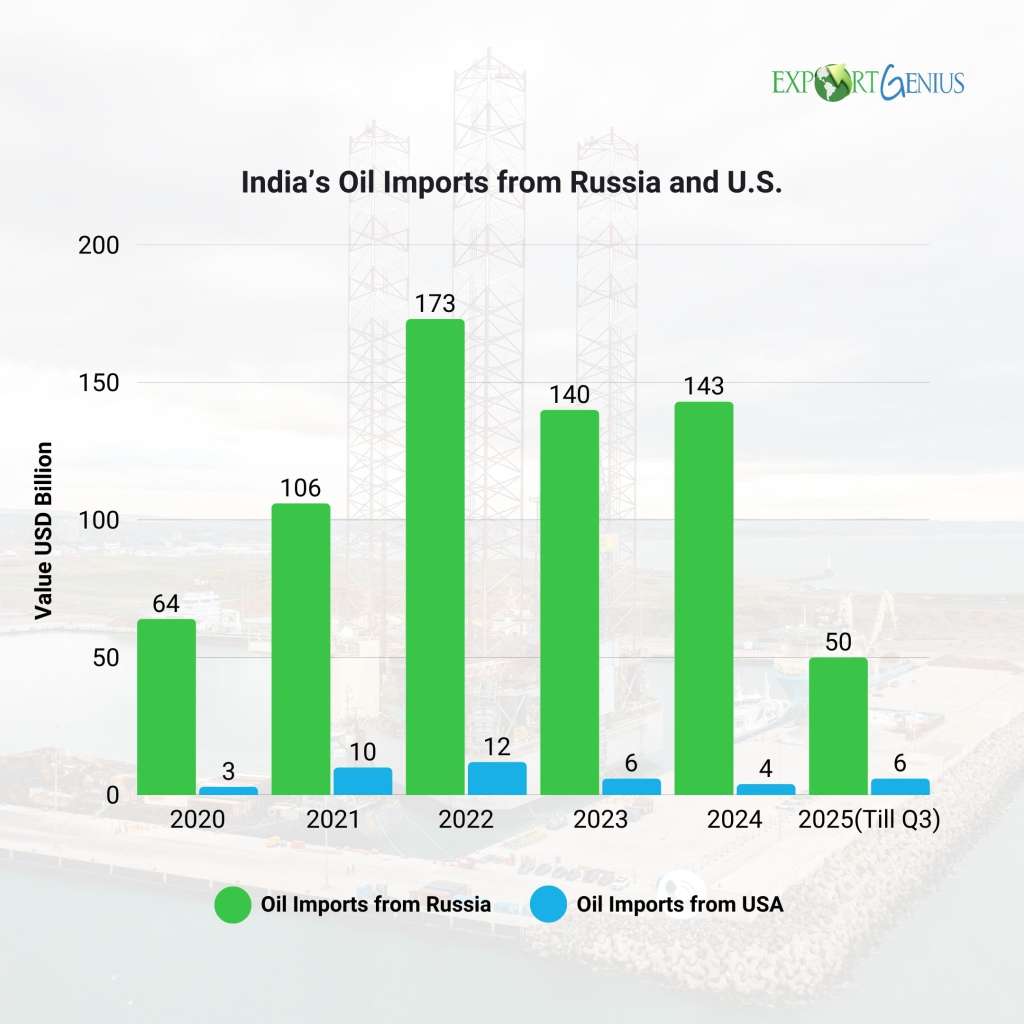
| Year | Oil Imports from Russia | Oil Imports from US |
| 2020 | 64 | 3 |
| 2021 | 106 | 10 |
| 2022 | 173 | 12 |
| 2023 | 140 | 6 |
| 2024 | 143 | 4 |
| 2025 (Till Sep) | 50 | 6 |
*****Value USD Billion
Implications for India-US Trade Relations
India-US trade valued at over USD 120 billion in 2024, could face ripple effects across multiple sectors if tariff threats turn into policy action. Before listing down implications for India-US trade, here’s a quick look at India’s trade with US in the past years.

| Year | India’s Exports to US | India’s Imports from US |
| 2020 | 49 | 26 |
| 2021 | 71 | 41 |
| 2022 | 80 | 51 |
| 2023 | 75 | 44 |
| 2024 | 80 | 43 |
| 2025 (Title Sep) | 68 | 35 |
****Value USD Billion
Here’s major points related to Trump India tariff impact 2026, if India would not stop purchasing oil from Russia.
- Rising Policy Uncertainty: Even without immediate action, tariff warnings create uncertainty. Businesses may delay contracts, rethink sourcing strategies, or renegotiate pricing to account for potential duty increases. Such uncertainty can slow trade momentum and investment decisions.
- Export-Heavy Sectors Could Face Pressure: If US tariffs on India are imposed, several Indian export sectors could be affected, including:
- Pharmaceuticals and medical supplies: The U.S. is the largest export market for Indian generic drugs. FDA compliance costs are already high; tariffs further squeeze margins.
- Textiles and apparel: Competes with Vietnam, Bangladesh, and Cambodia. Even small tariffs can erase cost advantages. Export slowdown directly impacts employment.
- Engineering goods and machinery: Parts are embedded in U.S. manufacturing and infrastructure projects. Long-term contracts limit ability to absorb tariff costs. Buyers can switch to Mexico or East Asia.
- Automotive components: Tariffs disrupt cost and delivery schedules. U.S. safety and quality norms add to cost pressures. Near-shoring makes Indian suppliers more vulnerable.
- Electronics and IT hardware: Many components are sourced from China and East Asia, compounding tariff impact. Margins are thin, making tariffs difficult to absorb.
Which are India’s top exports to US?
India’s top export commodities to US are electrical machinery & equipment, pharmaceutical products, nuclear reactors, boilers, machinery & mechanical appliances, pearls & precious stones, articles of iron & steel, and mineral fuels & oils.
| Product | 2024 | 2025 (Till Q3) |
| Electrical Machinery & Equipment | 80 | 17 |
| Pearls & Precious Stones | 12 | 4 |
| Pharma Products | 9 | 7 |
| Nuclear Reactors, Boilers, Machinery, etc. | 8 | 3 |
| Mineral Fuels & Oils | 6 | 3 |
| Articles of Iron & Steel | 4 | 1 |
| Other Made-up Textile Articles | 2 | 1 |
| Vehicles Other Than Railway or Tramway | 2 | 1 |
| Organic Chemicals | 2 | 1 |
| Not Knitted or Crocheted Apparel & Clothing | 2 | 1 |
*****Value USD Billion
These industries rely heavily on the US market, making them particularly sensitive to trade policy shifts.
US–India Strategic Partnership: Key Overview
The US–India Strategic Partnership is a multi-dimensional relationship built on shared democratic values, economic interests, and regional security goals. Here are the core pillars and current dynamics:
- Defense & Security Cooperation
India is a Major Defense Partner of the U.S. Strong collaboration through Quad (US–India–Japan–Australia) to ensure a free and open Indo-Pacific. Growing defense trade, joint military exercises (e.g., Malabar, Yudh Abhyas), and technology sharing.
- Trade & Economic Ties
The U.S. is one of India’s largest trading partners. Key sectors: IT services, pharmaceuticals, engineering goods, electronics, and energy. Ongoing friction over tariffs, market access, and trade imbalances, but long-term growth potential remains strong.
- Energy & Climate Cooperation
Collaboration on clean energy, renewables, and LNG trade. India’s purchase of Russian oil has recently emerged as a sensitive issue, linking energy choices to trade and diplomacy. Joint initiatives on climate finance and green technology.
- Technology & Innovation
Strategic focus on semiconductors, AI, critical minerals, 5G/6G, and space. The India–US Initiative on Critical and Emerging Technology (iCET) strengthens supply chain resilience and innovation.
- Geopolitical Alignment (with Strategic Autonomy)
Shared concerns over China’s influence in the Indo-Pacific. India maintains strategic autonomy, balancing ties with Russia while deepening U.S. engagement. Differences exist, but dialogue channels remain active.
- People-to-People Ties
Over 4.5 million Indian-origin people in the U.S.
Strong links via education, startups, skilled migration (H-1B visas), and cultural exchange.
Impact on Supply Chains and Global Sourcing
Tariffs often lead to supply chain realignment. In response to higher duties, US buyers may:
- Diversify sourcing to countries like Vietnam, Mexico, or Eastern Europe
- Increase nearshoring to reduce geopolitical risk
- Renegotiate long-term supplier agreements
On the other hand, Indian exporters may accelerate efforts to expand into Europe, ASEAN, Africa, and the Middle East to reduce reliance on the US market.
Strategic Challenges for India
India faces a delicate balancing act:
- Ensuring affordable and reliable energy supplies
- Preserving strategic and economic ties with the US
- Maintaining export competitiveness in key markets
While a full-scale trade confrontation appears unlikely, selective tariffs or stricter trade scrutiny could still impact export growth—especially for small and mid-sized businesses.
Broader Global Trade Consequences
Trump’s tariff warning highlights a larger trend in global trade:
- Geopolitics increasingly influencing trade policy
- Energy security becoming a strategic trade issue
- Tariffs being used as leverage rather than protection alone
Such developments add volatility to global markets and reinforce the need for diversification and resilience in trade strategies.
What Businesses Should Watch Closely
To navigate the evolving situation, exporters and importers should:
- Track shifts in trade volumes and buyer behavior
- Monitor policy developments and tariff announcements
- Explore alternative sourcing and export markets
- Review pricing, margins, and contract terms
Early adaptation often determines which companies can withstand trade disruptions and which struggle.
Conclusion
Trump’s tariff warning over India’s Russian oil purchases serves as a reminder that global trade is no longer driven solely by economics. Political strategy, energy security, and diplomacy now play an equally important role.
While the final outcome remains uncertain, the potential impact on India–US trade is significant enough for businesses and policymakers to stay alert. In an era of rapid geopolitical shifts, preparedness and diversification remain the strongest safeguards against trade disruption. Stay informed about India Russian oil imports 2026 and grab market opportunities with Export Genius global import export trade data.