
The AI boom has shifted demand composition for memory and storage. That shift is tightening raising prices, DRAM supply, and re-shaping trade flows for SSDs and HDDs – with knock-on effects for exporters, OEMs, and downstream electronics industries. Export Genius explains why, how it shows up in export activity, and what companies and policymakers should do next. With relevant global trade data of HDD, SSD and DRAM, our experts share current picture of AI in international shipping and future possible trends.
To analyse the market, we have taken following HS Codes for HDD, SSD and DRAM.
- DRAM: HS Codes 847330 and 854232
- SSD: HS Code 852351
- HDD: HS Codes 852352 and 852359
Key Highlights
- AI-driven demand is tightening global DRAM supply and pushing price volatility into trade flows.
- SSD and HDD trade patterns are diverging as AI workloads favor high-performance storage.
- OEMs, exporters, and policymakers face structurally different planning assumptions.
- Export concentration risk is rising across key memory and storage producing economies.
Why AI has changed the global trade
Modern AI workloads large language models and large-scale training clusters. These consume vastly more memory per rack than traditional enterprise workloads. Hyperscale’s are buying specialized high-bandwidth memory (HBM), premium DRAM, and huge volumes of flash and cold storage, redirecting capacity and inventory away from consumer channels. This reallocation is creating supply tightness and price pressure across DRAM, SSD, and even HDD markets.
DRAM exports – the first and fiercest squeeze
DRAM is being prioritized for AI servers. Major memory suppliers have signalled strong AI-driven bookings and are shifting capex and allocations toward AI-grade memory. That reduces available packaging capacity for commodity DRAM used in PCs, phones, and consumer devices.
Trade effects: Major exporters of DRAM components are Taiwan, South Korea, Japan. They see increased shipments to cloud-operator hubs but simultaneously limited spot availability for other buyers. Inventory weeks for memory have fallen sharply in 2025 vs 2024, compressing export volumes available to secondary markets.
DRAM Exports by Country and Year
| Exporters of DRAM (HS Code 847330) | Value (2024) | Value (2025 Till Q1) | Exporters of DRAM (HS Code 854232) | Value (2024) | Value (2025 Till Q1 |
| World | 158 | 48 | World | 253 | 40 |
| China | 33 | 10 | South Korea | 72 | 1 |
| Hong Kong | 27 | 9 | China | 68 | 1 |
| United States | 23 | 8 | Hong Kong | 43 | 0.5 |
| South Korea | 16 | 5 | Singapore | 21 | 0.4 |
| Taipei, Chinese | 14 | 3 | Taipei, Chinese | 20 | 0.3 |
| Vietnam | 12 | 2 | Japan | 12 | 0.1 |
*****Value USD Billion
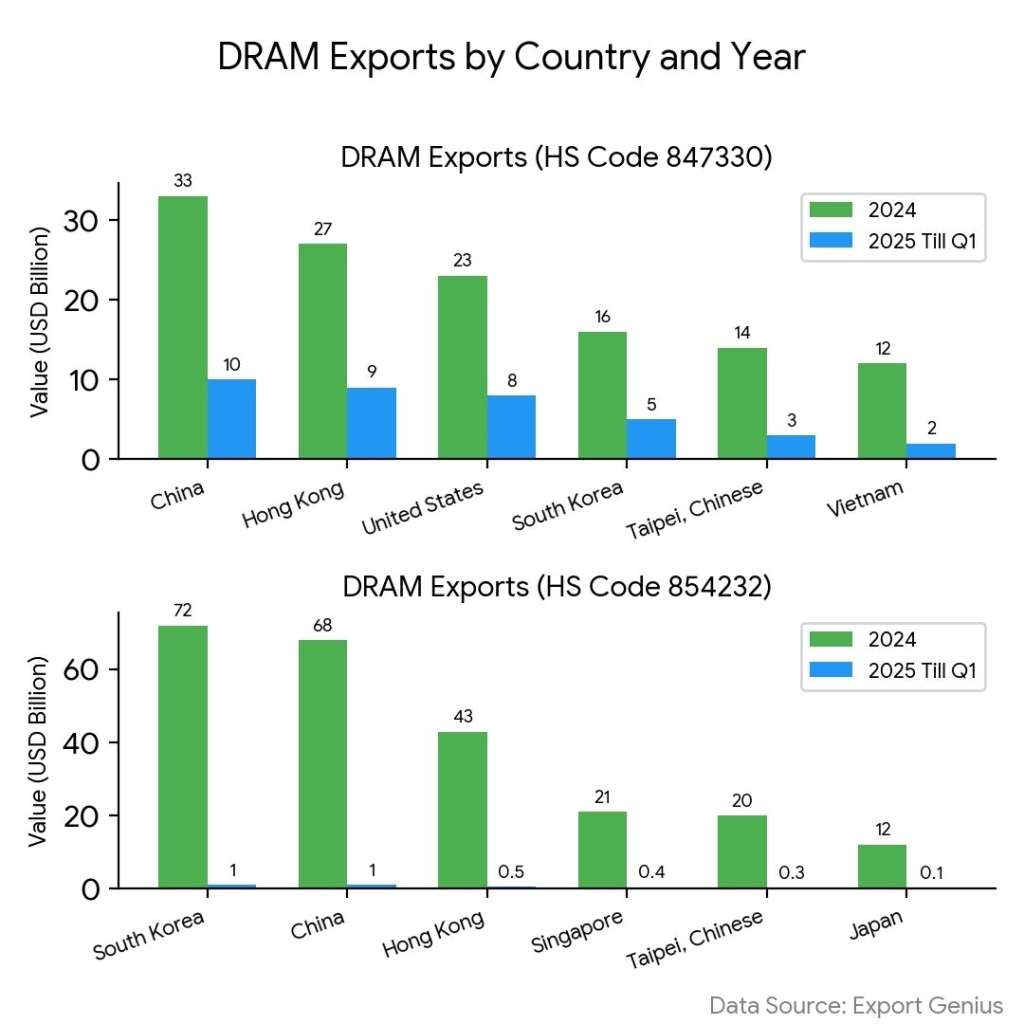
Price impact: DRAM prices increased significantly through 2025 as allocations tightened. Export Genius analysts warn shortages and higher prices could persist until new fabs and capacity come online.
Implication for exporters: Companies must look beyond unit volumes and track average selling price trends and allocation policies.
SSD Exports – Booming, but segmented demand
The global demand for data-center SSDs is on the rise for performance and throughput, while consumer/NVMe PC segments grow more slowly. Data-center SSD market estimates show strong year-over-year growth.
Exports & market value: Global SSD export values increased in 2024 and estimates indicate continued growth into 2025 as data-center purchases expand. Factors for this growth include higher prices, export dollar values rise faster than unit shipments.
SSD Exports by Year and Country
| Exporters of SSD (HS Code 852351) | Value (2024) | Value (2025 Till Q1) |
| World | 49 | 13 |
| South Korea | 10 | 7 |
| Taipei, Chinese | 8 | 4 |
| United States | 7 | 3 |
| Malaysia | 6 | 2 |
| Hong Kong | 5 | 1 |
| Singapore | 3 | 0.5 |
*****Value USD Billion

Supply constraints: There is a market tendency of buyers that they mix SSD tiers or temporarily increase HDD use for cold storage where flash supply is constrained. That behavior affects trade flows; more HDD tonnage for cold storage exports/imports, and higher-value SSD exports concentrated in regions serving hyperscalers.
Implication for exporters: Exporters that can offer higher-end SSDs will capture disproportionate revenue gains due to prioritize SSD SKUs and long-term contracts with hyper scalers or cloud providers.
HDD Exports – legacy tech, renewed relevance
AI workloads generate and archive colossal datasets. Cold-tier storage economics still favor high-capacity HDDs. Hyper scalers are therefore ordering more HDDs for bulk storage even as SSDs dominate performance tiers. This renewed demand has tightened HDD supply and lifted prices in 2025.
HDD Exports by Country
| Exporters of HDD (HS Code 852352) | Value (2024) | Exporters of HDD (HS Code 852359) | Value (2024) |
| World | 6 | World | 1 |
| China | 1 | Thailand | 0.2 |
| Hong Kong | 0.4 | Singapore | 0.2 |
| France | 0.3 | Malaysia | 0.2 |
| United States | 0.3 | United States | 0.1 |
| Germany | 0.3 | South Korea | 0.09 |
| Mexico | 0.2 | Germany | 0.06 |
*****Value USD Billion
Trade shifts: Countries like China that export large-capacity HDDs have seen export increases in capacity terms. Because HDDs are bulky and higher in per-shipment tonnage, freight and logistics constraints affect trade timing and costs.
Implication for exporters: Expect higher shipment values and larger, less frequent orders; optimize for freight capacity and negotiate longer lead times with carriers and component suppliers.
What Export Genius data solutions recommend for exporters, OEMs, and analysts
Exporters / Traders
- Track both unit and value series; report and forecast in USD and in units to capture price effects.
- Strengthen logistics partnerships to handle irregular, large shipments (HDD containers, hyperscaler-timed deliveries).
OEMs / Manufacturers
Prioritize product lines with better margin capture where feasible.
Lock multiyear supply agreements for critical memory parts; invest in qualifying alternate suppliers and cross-qualification of components.
Policy makers and trade analysts
- Track concentration risks.
- Support industrial policy that reduces single-point-of-failure exposure in memory ecosystems.
The Last Words
A sharp increase of AI is reshaping global supply lines for DRAM, HDD, and SSDs in ways that go far beyond traditional demand cycles. As hyper scalers and data centers absorb a growing share of memory and storage capacity, export patterns are shifting toward tighter allocations, higher-value products, and increased price volatility. For exporters, manufacturers, and trade analysts, success now depends on understanding not just volumes, but sourcing concentration, value trends, and destination-level demand driven by AI infrastructure growth.
Export Genius helps you stay ahead of these market shifts by providing updated and latest global trade data with in-depth insights. This empowers you to track AI-driven changes in HDD, DRAM, and SSD exports with confidence. Explore global import export trade data to identify opportunities early, benchmark competitors, and make smarter, data-backed decisions in an AI-driven trade landscape.
Frequently Asked Questions
Why are DRAM prices rising in 2025?
DRAM prices are rising in 2025 because AI-driven data-center demand is growing faster than supply, especially as manufacturers prioritize high-bandwidth memory for AI workloads.
At the same time, limited capacity expansion and concentrated export flows are tightening availability for traditional electronics markets, pushing prices higher.
Which HS codes track DRAM, SSD and HDD exports?
DRAM exports are tracked under HS code 847330 and 854232 for memory integrated circuits like dynamic RAM, SSDs are classified under HS code 852351 for solid-state non-volatile storage devices, and HDDs use HS code 852352 and 852359 for computer storage units in international trade data.
Which countries are exporting the most memory in 2025?
In 2025, South Korea leads global memory exports, driven by DRAM and NAND shipments from Samsung and SK Hynix, followed by China and Taiwan as major exporters of memory chips and storage products.
Japan and Singapore also play important roles as high-value manufacturing and re-export hubs within the global memory supply chain.
How can exporters detect AI-driven demand shifts early?
Exporters can detect AI-driven demand shifts early by tracking changes in destination markets, divergence between shipment volumes and export values, and sudden spikes in lead times or delivery urgency.
Together, these signals indicate buyers prioritizing AI-related capacity and reallocating supply ahead of broader market shifts.
What steps can OEMs take to secure memory supplies?
OEMs can secure memory supplies by diversifying sourcing across regions, locking in long-term contracts with key suppliers, and prioritizing demand forecasting using trade and shipment data.
Proactive inventory planning and closer alignment with suppliers help reduce exposure to AI-driven supply tightness and price volatility.